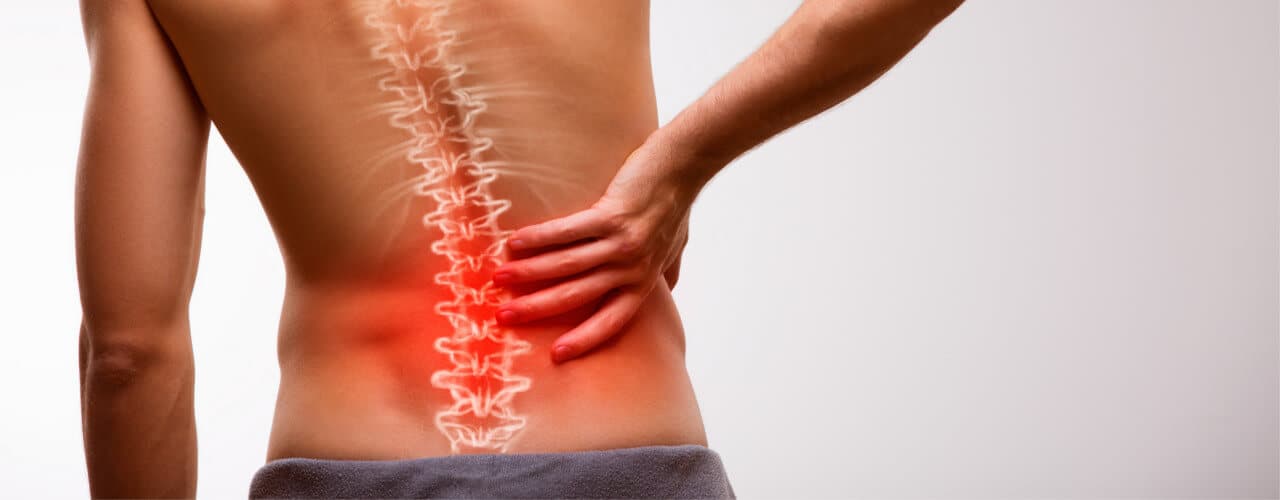

A patient comes in with low back pain. I check their hip range of motion. Almost every time, someone asks the same reasonable question: "why are you looking at my hip? My back is what hurts." It's a good question, and the honest answer is a real, formally described model in physiotherapy called regional interdependence.
What regional interdependence actually is
The term was formalised in 2007 by Wainner and colleagues in the Journal of Orthopaedic & Sports Physical Therapy, who defined it as the concept that "seemingly unrelated impairments in a remote anatomical region may contribute to, or be associated with, the patient's primary complaint."1 In 2013, Sueki, Cleland and Wainner expanded it into a broader model — not just joints and muscles talking to each other mechanically, but a genuinely interconnected system worth examining as a whole rather than one sore segment in isolation.2
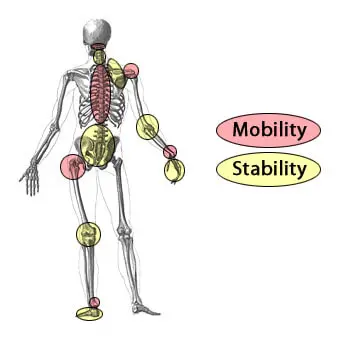
In plain terms: your back doesn't work in isolation. It sits between your hips and your ribcage, and how those regions move — or don't — changes the load your lumbar spine has to absorb. A proper back assessment looks at the whole chain, not just the part that hurts.
The best-evidenced example: your hip
Of all the regions studied alongside the low back, the hip has the most consistent evidence behind it. A study of professional golfers found that low back pain was associated with reduced hip and lower-back range of motion together, not the back alone.3 A separate study comparing active adults with chronic low back pain against pain-free controls found a genuinely large difference in passive hip extension — roughly 11 degrees less on average in the group with back pain, with no equivalent difference in hip rotation.4 That's specific: it's not "hips matter generally," it's a particular movement, in a particular direction, showing up again and again in people with back pain.
The logic isn't hard to follow. If your hip can't extend properly — the movement your leg makes swinging behind you when you walk, or straightening up from a forward bend — something else has to make up that range. Almost always, it's your lumbar spine picking up the slack, moving into more extension than it's really designed to on every stride and every bend, day after day.
That matters specifically because of where the load lands. The lumbar spine's facet joints — the small paired joints at the back of each vertebra — are built to bear weight during extension and rotation. Ask them to do that job more often than they should, because the hip upstream isn't contributing its share, and you have a direct, mechanical route to facet-mediated back pain: the kind that's often worse with standing, walking, or arching backward, and eased by bending forward. Restricted hip extension doesn't just correlate with back pain in the research — it gives you a specific, testable reason for a specific pattern of symptoms.
How we actually screen for this: the SFMA
Knowing that remote regions matter is one thing. Having a structured way to actually find which ones matter for a given person is another. That's what the Selective Functional Movement Assessment (SFMA) gives us — a movement-screening framework developed by Gray Cook and colleagues that runs a person through a set of full-body movement patterns, rather than jumping straight to the sore segment.
In practice, this is regional interdependence turned into a repeatable clinical process.
Hamstring flexibility is another region the SFMA routinely flags, and it's backed by the same kind of evidence as the hip: a 2017 systematic review that specifically pooled prospective studies — people measured before any back pain existed, then followed over time — found reduced hamstring flexibility predicted who went on to develop low back pain.5 The mechanism is straightforward: shorter hamstrings limit how far the hip can flex, so bending forward has to borrow that missing range from somewhere — and the lumbar spine is what's left to give it up. Over years of doing that on every forward bend, the spine is carrying more repetitive flexion load than it was built for, which is a credible driver of flexion-type back injuries, disc-related pain among them.
Worth being precise about what "tight hamstrings" actually means here, though. As I've written about separately, a muscle that feels tight usually hasn't physically shortened — more often it's the nervous system holding it under more tone than usual. Therefore, it is not simply enough to say "you have tight hamstrings, we need to stretch them." We need to determine the cause of that tightness and provide proper rehabilitation to allow the hamstrings to genuinely let go. Looser hamstrings, achieved that way, are what actually take the pressure off the lumbar spine — not a stretch held for thirty seconds before every session.