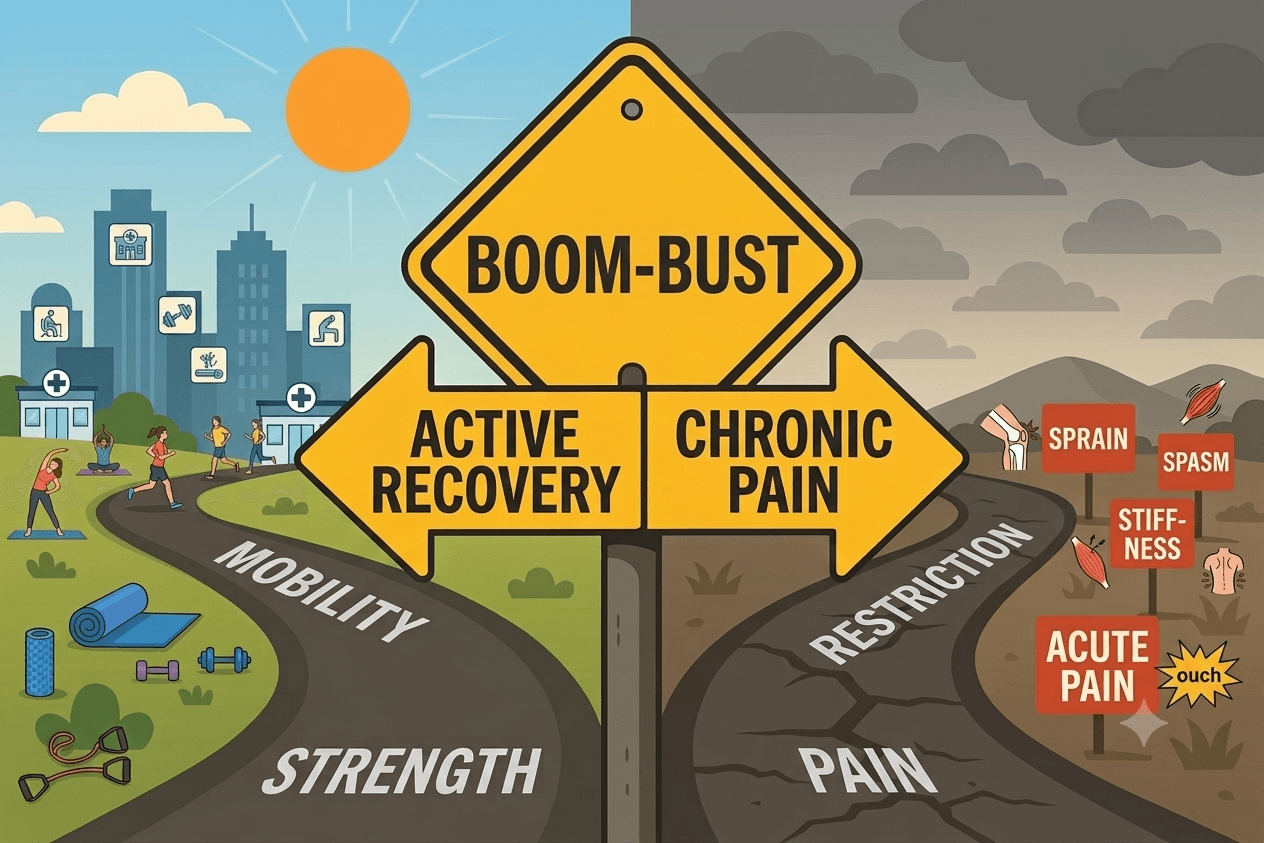

If you live with persistent pain, this pattern might sound familiar. You wake up on a good day and feel like yourself again, so you make the most of it — the lawn, the shopping, the cleaning, everything you've been putting off. Then, later that day or the next morning, it hits: a flare-up. You rest, sometimes for days, and the list you cleared quietly starts rebuilding itself. Once the flare eases, you do it all again.
This is the boom-bust cycle, and it's one of the most common — and most misunderstood — patterns in persistent pain.
Why the boom-bust cycle keeps you stuck
On the surface it looks like the pain is simply unpredictable — good days and bad days, out of your control. But there's a mechanic driving the cycle, and it's been described in the pain literature for decades. Physiotherapist and psychologist William Fordyce's original model of chronic pain behaviour, published in 1976, was one of the first to describe exactly this pattern: activity driven by how good the pain currently feels, rather than by a plan — followed by a crash, followed by rest.1
Every time you "boom" — pushing hard because you finally feel capable — you overload your body well past what it's currently ready for. That triggers a flare, and a flare demands rest. But prolonged rest has a cost: your muscles decondition, your joints stiffen, and your general fitness and tolerance for activity drops.
The next time you try the same task, your body has less capacity than it did before, so the same amount of activity now tips you into a flare-up more easily than it used to. Your threshold keeps dropping with each cycle. The result is a slow downward spiral: less capacity, earlier flare-ups, more rest, even less capacity again. Over time, pain stops being something that happens to you occasionally, and starts to feel like it's running your life — dictating what you can and can't do, and when.

The boom-bust cycle trends downward over time. A paced approach, kept under the flare-up threshold, allows capacity to gradually rebuild instead.
The remedy: the 3 Ps — pacing, planning, prioritising
The way out of this cycle isn't to push harder, and it isn't to rest more either. It's to change how activity is spread out. Activity pacing specifically — breaking tasks into planned chunks with built-in rest, rather than letting how you feel in the moment decide4 — is one of the most consistently used strategies in chronic pain management, and a 2012 systematic review found it's genuinely associated with better day-to-day functioning.3 But before pacing can actually work, there's a step that has to come first.
Step one: acceptance
Before the 3 Ps can be put into practice, there needs to be an honest acknowledgement of where things currently stand: that you're in a boom-bust pattern, that doing things the way you used to isn't realistic right now, and that change means doing things differently — not just doing less or waiting for a cure.
This isn't about accepting that pain will always limit you. It's about accepting the current starting point clearly enough to actually build a way forward from it. Trying to pace while still believing "I should be able to do this in one go, like I always have" usually leads straight back into the cycle — a pattern well described by the fear-avoidance model of chronic pain, where how a person interprets and responds to pain shapes what they do next at least as much as the pain itself does.2
1. Pacing
Pacing means breaking a task into smaller chunks, with planned rest in between — before pain forces you to stop. Instead of mowing the entire lawn in one go because that's "how it's always been done," you might mow the front third, take a 15–20 minute break, mow the next section, break again, and finish the last part later that day or the next. The task still gets done — just not all at once, and not at the cost of a flare-up.
Crucially, pacing rest breaks are taken by the clock or by the plan, not by the pain. Resting before symptoms spike, rather than after, is what keeps you under your flare-up threshold instead of crashing through it.
2. Planning
Planning means looking ahead at the days and week as a whole, rather than reacting to how you feel in the moment. If the lawn needs mowing, the shopping needs doing, and the house needs a clean, planning means deciding in advance which day each task happens — rather than cramming them all into one "good day" because you're not sure when the next one will come.
3. Prioritising
Prioritising means being deliberate about what actually needs to happen, and letting go of — or delaying — the rest. If the lawn, the shopping, and the cleaning all feel urgent, prioritising means asking: what genuinely needs to happen today? Maybe the shopping is essential, the lawn can wait until tomorrow, and the cleaning can be split into smaller jobs across the week.
Used together, pacing, planning and prioritising stop any single day from asking more of your body than it can currently give — which is exactly what keeps you underneath your flare-up threshold instead of repeatedly crashing through it.